
Your Holiday Playbook Is Outdated

5 Ways to Win Book Sales in the Age of AI Search
For many book publishers, the final months of the year bring a familiar sense of anxiety. The holiday season is critical, but this year, the ground is shifting beneath our feet. Publishers are already observing noticeable drops in search traffic during what should be the most important discovery period for gift-givers.
Big changes have been coming since June. This isn’t a temporary dip; it’s a signal of a fundamental paradigm shift. Two major forces—1) a change in how and when consumers shop, and 2) the rise of AI-driven search—are demanding that we pivot our entire marketing approach from a traffic-acquisition model to an authority-building one.
This playbook distills these complex changes into five key takeaways that reframe the path to success. The goal is no longer just winning clicks; it’s about establishing credibility and becoming the definitive source in a new digital landscape.
The Holiday Season Isn’t a Sprint—It’s a Marathon
The traditional, concentrated holiday shopping rush—Black Friday to early December—is a thing of the past. The season has expanded, now spanning from October all the way through January as budget-conscious shoppers do more research and spread out their spending to find the best deals.
The data confirms this trend: a recent consumer survey revealed that more 63% of shoppers plan to do most of their holiday shopping mid-to-late fall (October to early December), with a significant 25% starting before the end of October.
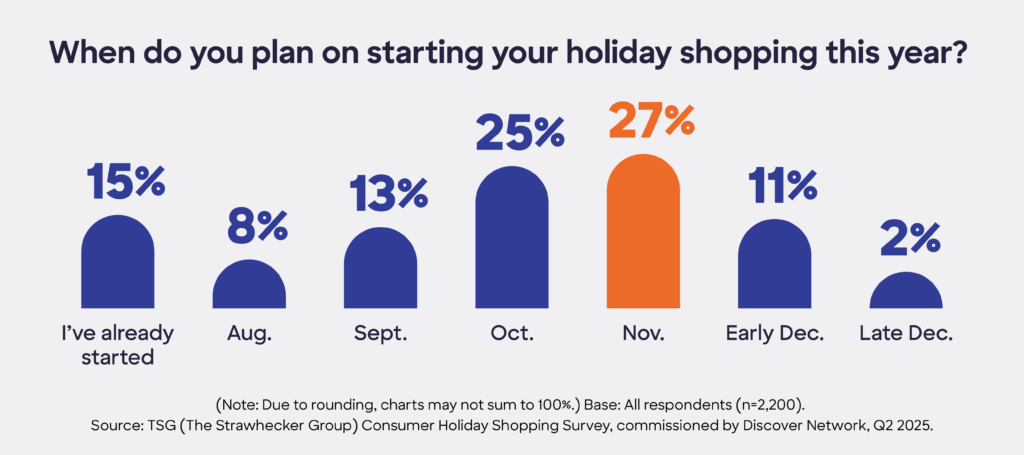
Tip #1: For book publishers, this longer season demands a revised marketing calendar. The strategy of launching gift guides and “best of the year” lists after American Thanksgiving is not sufficient. To capture early demand, your promotional efforts must ideally begin in October. A seasoned strategist would recognize this as a shift in content type: your October strategy should focus on high-level inspiration and discovery, while your late November efforts pivot to urgency and conversion.
Shoppers Are Playing Detective, and You Need to Leave Clues
Modern holiday shopping is defined by two key traits: budget-consciousness and a fragmented discovery journey. Today’s shopper is more deliberate, seeking not just products but inspiration and validation before making a purchase.
Here’s a look at the modern shopper’s mindset:
- They’re on a budget: 70% of consumers plan to create a holiday shopping budget, and 34% report they may buy fewer gifts this year to reduce their expenses.
- They’re seeking inspiration: Over 60% of Google queries are now broad and conversational. Shoppers aren’t just searching for a specific book; they’re looking for ideas with queries like “Jane Goodall books for kids” or “books for 6 year olds to read to themselves.” [These are real queries you can find in Google Trends over the last 30 days.]
- They’re searching everywhere: The user journey is decentralized. It can start on platforms like YouTube, TikTok, Reddit, or ChatGPT long before a user ever lands on a publisher’s website or even a traditional search engine.
Tip #2: Your marketing goal must be to ensure your titles appear as answers and recommendations across these various channels. This means your “best historical fiction gift guide” shouldn’t only be a page on your site; it needs to be the source material for a TikTok video, a reference in a Reddit thread, and the basis for a YouTube short.
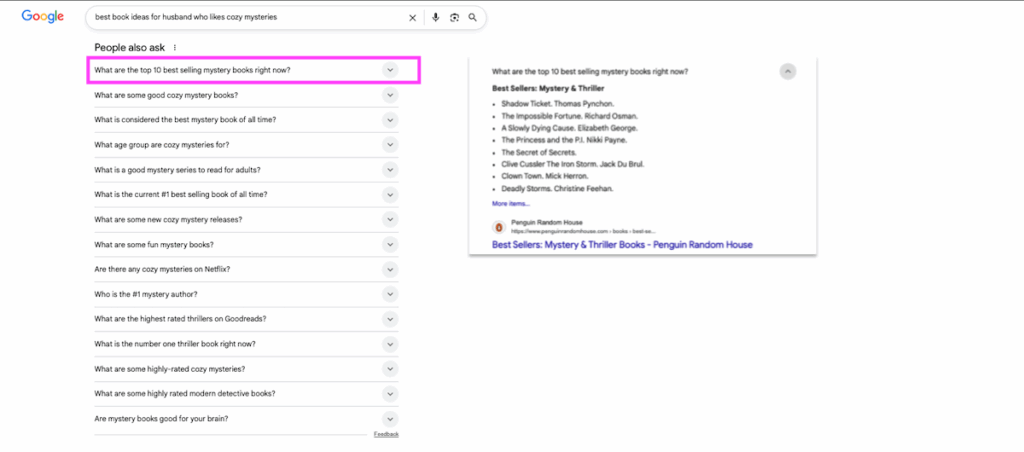
Better still is having the right structure and content on your page so you can win a spot in the AI Overview or the “People also ask” box (PAA). The PAA on this results page for “What are the top 10 bestselling mystery books right now?” is a collection page on Penguin Random House.
Your Biggest Competitor Isn’t Another Publisher—It’s the Search Page
The rise of zero-click search, powered by features like Google’s AI Overviews, has introduced a new primary competitor: the search results page itself. AI now synthesizes information from multiple websites to provide a direct answer to a user’s query. This means we’re shifting from competing for rankings to competing for mentions within an AI-generated consensus. In other words, the new goal is to be cited as an authoritative source when generative AI models like Google’s AI Overviews, Perplexity, and ChatGPT synthesize information for a user query.
Why does it matter? A potential customer might get a book recommendation without ever needing to visit your site.
The impact of this shift cannot be overstated.
Here’s a look at the AI Overview for “best book ideas for husband who likes cozy mysteries.”
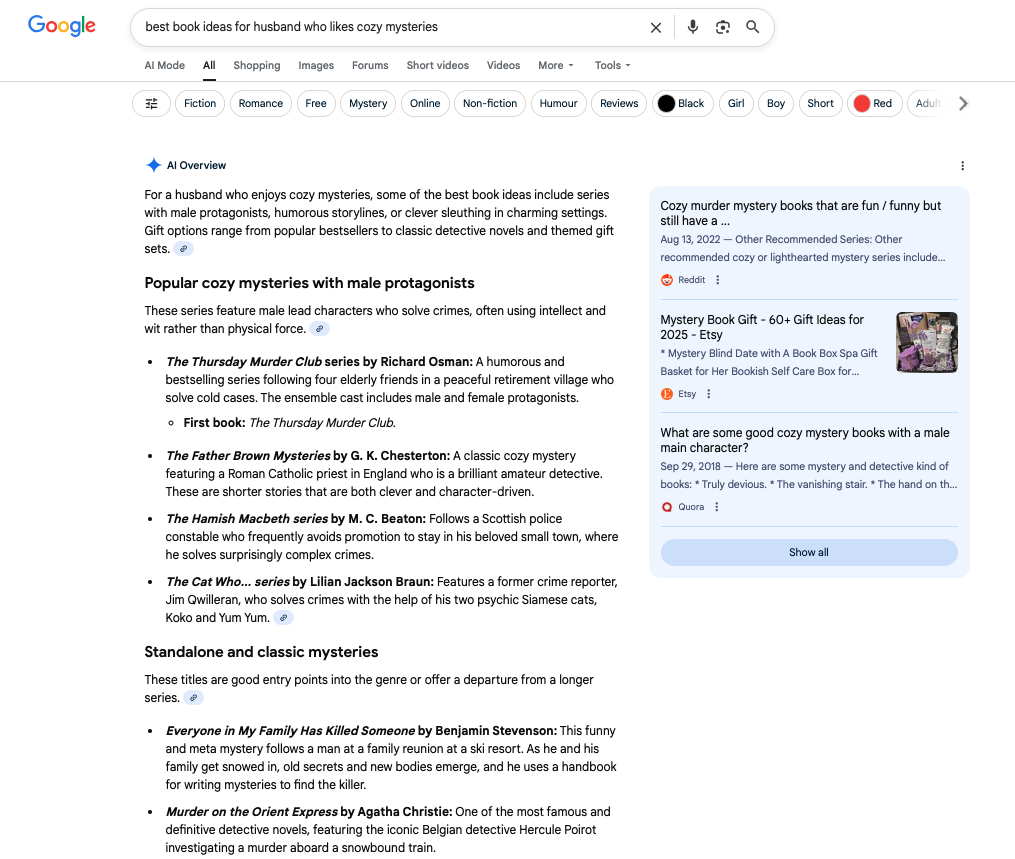
Tip #3: This season, publishers should expect fewer sessions from organic search as AI summaries and carousels dominate the results for holiday-related queries.
While seeing organic traffic decline can be alarming, it signals a necessary pivot. [Context is also key: as of May 28, 2025, Google began tagging traffic from AI Overviews as “Google / organic,” so the loss may be one of direct control, not total visibility.] The goal is no longer just about getting the click. It’s about ensuring your book is so authoritatively presented online that it gets prominently featured within the AI-generated answers that users now see first.
Winning Clicks Is Good, But Being the Source Is Better
This holiday season, people are turning to chatbots for gift ideas vs. Google. [Update: Nov 24, 2025 ChatGPT introduced shopping research tools for discovering new products, comparing items, choosing gifts, and finding deals.]
In this new environment, which many are calling the Agentic Internet, the primary SEO goal is no longer just to rank #1. It’s to become the authoritative source material that an AI agent uses to formulate its answer. To do this, publishers must now optimize for the Agent Experience (AX) just as much as the User Experience (UX), ensuring content is as machine-readable as it is human-readable. [Confused by the terms? SEO, AEO, and GEO are different optimization strategies for search and AI. Here’s an explainer. Basically I don’t care what you call it, we are optimizing for visibility, credibility, and conversion.]
Tip #4: Here are actionable steps to “become the source”:
- Embrace structured content: Use schema for book titles, authors, and reviews. This machine-readable data makes it easy for AI tools to understand your content and surface your listings accurately. That’s how PRH ended up in that People Also Ask box.
- Optimize pages for intent: Create and update gift guides that match how real people search. A generic guide titled “Best Sci-Fi of the Year” will be ignored; a specific page like “Best Sci-Fi Gifts for Fans of Dune” directly answers a niche query and is more likely to be sourced by AI.
- Build brand authority: Consistently produce helpful, people-first content that establishes your press as a trusted expert. Authoritative content is what AI is designed to find and feature.
In the age of AI search, being mentioned in an AI Overview is a significant marketing win. Visibility and credibility are the new metrics for success.
Your Secret Weapon Is an Offer They Can’t Get on Amazon
That budget-conscious shopper you met earlier isn’t just looking for discounts; they’re looking for value. As book discovery becomes decentralized and AI provides recommendations, your exclusive offers are not just perks; they are the definitive answer to a shopper’s search for a smarter, more valuable purchase. Once an AI helps them discover your book, you must give them a compelling reason to buy directly from you.
Tip #5: Consider these exclusive offerings to drive direct sales and capture higher margins:
- Signed copies from the author.
- Exclusive book bundles or curated gift sets.
- Bonus content available only with a direct purchase (e.g., a downloadable author Q&A, a prequel short story, or behind-the-scenes material).
These exclusives serve as powerful, value-added incentives that frame a direct purchase not just as a preference, but as the most intelligent choice.
From Clicks to Credibility
The challenges of this holiday season are not a signal of lost opportunity but a call to adapt. Success no longer hinges on traditional traffic metrics alone. Instead, it will be defined by a publisher’s ability to achieve widespread visibility across multiple platforms, establish authority in their categories, and provide unique value that converts discovery into direct sales.
As AI becomes the new digital storefront, how will you steal the spotlight, without letting AI stealing your lunch?
Want help?
Let’s set up a search and analytics audit for your holiday campaigns, or subscribe to the newsletter for more insights.


Ways to Support Author Marketing

Measuring the Impact of Publicity

Year-End Review Framework for Publishers

Year-End Review Template for Agencies & Consultants

Your Holiday Playbook Is Outdated