
BC + AI Ecosystem
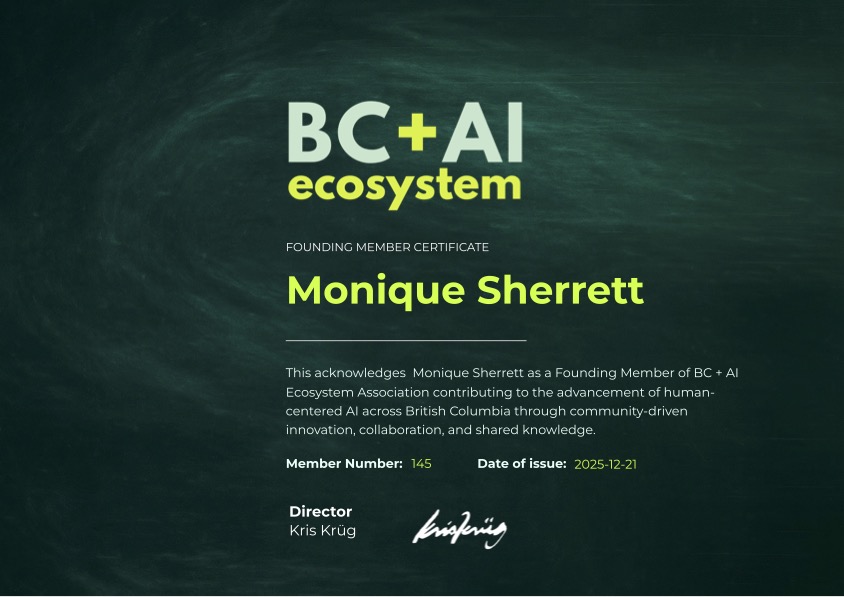
Becoming Founding Member #145 of BC + AI Ecosystem Association feels both timely and necessary. AI is already reshaping how cultural work is discovered, produced, distributed, and valued.
- Discovery: Streaming platforms and digital libraries use AI to tailor discovery based on behavioural analysis. Add to that, Natural Language Processing (NLP) allows people to search “A fantasy book with a smart, witty female lead and a slow-burn romance” rather than looking up titles or browsing through categories. Our behaviour has changed and the tools available have changed.
- Production: AI music and film are advancing at a breath-taking rate. Check out Tippett.org for how AI is altering filmmaking and media creation. Back to books, authors are self-reporting their use of Sudowrite, ChatGPT and Claude to generate plot ideas, character names, and story outlines—sometimes to generate first drafts or to expand scenes. We are well beyond using AI tools for grammar and style checks. AI tools are used (can be used) to analyze chapters and provide feedback, to automate book cover design, to streamline formatting and layout, to create audiobook narration or translated works. But very few want to talk publicly about this. Surely the Big 5 are using predictive analytics to analyze market trends and reader data, to create book blurbs, ad copy, social media posts, better targeted ads?
- Distribution: I know the least about this side of the market but I do know Amazon (and others) uses demand forecasting and dynamic pricing. Plus shipping and logistics companies use AI for inventory management, dynamic route planning, and warehouse automation.
- Values: There’s a lot of conversation about AI being unethical and destructive to art and literature. But does that reflect what we value? Or do actions speak louder than words? What happens when your competitors assess manuscripts based on projected vs. historical sales of comp titles or use AI-agents to determine marketability? How can indie booksellers compete if larger players are maximizing profitability with dynamic pricing based on real-time competitor pricing, demand, consumer behaviour? What we think and feel is in contrast to what some feel they are forced to do to keep up.
AI raises urgent questions about authorship, labour, compensation, and visibility. It also raises ecological concerns: the energy demands of large models, the infrastructure required to sustain them, and the very real environmental cost embedded in the tools we are being encouraged to adopt.
Dear Canadian communities, reject tech company offers to build AI datacentres in your area. There are some upfront jobs but the trade-off in terms of long-term jobs is not there. More important, these facilities need clean, filtered water to run. That puts your drinking water into direct competition. As the Canadian government website says, “it is easy for Canadians to assume that they have an almost endless supply of clean, fresh water … however, less than half of this water — about 7% of the global supply — is renewable.” Of the clean, fresh water available, that supply of water is “heavily used and often overly stressed.” My two cents: don’t do it.
My hope in joining the BC + AI Ecosystem is to learn and to listen—especially to artists, technologists, policymakers, and community leaders grappling with what’s at stake. I want to connect with businesses, like mine, who are trying to use AI without abandoning their values, even while acknowledging the contradictions we’re operating within—including the uncomfortable reality that these platforms are trained on stolen or uncompensated IP.
There are no neat answers, but I do believe participation in the conversation matters.
So far, my experience with BC + AI has been that the people in the room care about ethics, ecology, and creative integrity. I’m looking forward to the 25th monthly meetup and the keynote from social scientist, technologist, and tech journalist Alexandra Samuel on her Me + Viv podcast, exploring AI decisions and trade-offs, plus presentations from Erica Lapadat-Janzen, who works with SFU’s Metacreation Lab on artist-led model training, on extraction, consent, and who gets to set the terms, and Maya Bruck on design thinking for vibe coders, bridging the gap between “ship fast” and “ship well.”


Ways to Support Author Marketing

Measuring the Impact of Publicity

Year-End Review Framework for Publishers
Year-End Review Template for Agencies & Consultants

Your Holiday Playbook Is Outdated